Mandelic acid offers gentle exfoliation for acne, pigmentation, texture, and dullness, while glycolic, salicylic, Jessner’s, retinol, and TCA peels target different concerns. Learn how dermatology professionals choose the right peel for your skin.
When your skin looks dull, congested, uneven, or rough, a professional chemical peel can be an effective way to refresh your complexion. But with options ranging from mandelic acid and salicylic acid to glycolic acid, Jessner’s, retinol, and TCA peels, choosing the right treatment can feel overwhelming.
The key is understanding that not every chemical peel is designed to treat the same concerns. The best peel depends on your skin type, sensitivity, pigmentation, acne, texture, goals, and how much downtime you are comfortable with.
At MDCS Dermatology, chemical peels are customized to address concerns including acne, pigmentation, dullness, uneven texture, fine lines, enlarged pores, and sun damage. The practice offers several medical-grade peel options, including mandelic acid, glycolic acid, salicylic acid, TCA, Jessner’s, retinol, Glytone, and SkinMedica formulations.
What Is a Mandelic Acid Peel?
Mandelic acid is an alpha hydroxy acid (AHA) derived from bitter almonds. Like other AHAs, it exfoliates the skin by helping loosen the bonds between dead skin cells on the surface.
What makes mandelic acid different is its relatively large molecular size. This allows it to penetrate the skin more slowly and evenly than some smaller AHAs, making it a popular option for patients who want effective exfoliation with a gentler approach.
Mandelic acid peels can help improve:
-
Uneven skin tone
-
Dark spots
-
Post-inflammatory hyperpigmentation
-
Acne
-
Congested pores
-
Rough texture
-
Dullness
-
Overall skin clarity
MDCS Dermatology specifically describes mandelic acid peels as a gentle option that can be well suited for sensitive or pigmentation-prone skin.
Why Choose Mandelic Acid?
One of the biggest advantages of mandelic acid is its balance between exfoliation and tolerability.
Some patients want the benefits of a chemical peel but are concerned about significant irritation, prolonged peeling, or downtime. Mandelic acid may provide a more gradual approach to improving the surface of the skin.
It can be especially appealing for patients with:
Sensitive Skin
Because mandelic acid penetrates more slowly, it may be better tolerated than some stronger acids.
Acne-Prone Skin
Mandelic acid can help exfoliate dead skin cells and improve congestion, supporting clearer-looking pores.
Uneven Pigmentation
It can help improve the appearance of certain types of discoloration, including post-acne marks and superficial hyperpigmentation.
Deeper Skin Tones
Gentle treatment selection is particularly important for patients who are prone to post-inflammatory hyperpigmentation. Mandelic acid may be an appropriate option for some patients because of its relatively gentle profile.
However, "gentle" does not mean appropriate for everyone. Your skin should still be evaluated before treatment.
Mandelic Acid vs. Glycolic Acid
Both mandelic and glycolic acids are AHAs, but they behave differently in the skin.
Glycolic acid has a smaller molecular structure and generally penetrates the skin more readily. This can make it a powerful exfoliating option for improving:
-
Dullness
-
Rough texture
-
Fine lines
-
Uneven pigmentation
-
Early signs of photoaging
Mandelic acid, by comparison, penetrates more slowly and may be preferable when sensitivity is a concern.
Which Is Better?
Neither is universally "better."
If your primary concern is significant dullness or texture and your skin tolerates stronger exfoliation, glycolic acid may be considered.
If your skin is sensitive, acne-prone, or more susceptible to irritation, mandelic acid may be a better starting point.
Your treatment should be selected based on your skin—not simply the strength of the acid.
Mandelic Acid vs. Salicylic Acid
Salicylic acid is a beta hydroxy acid (BHA) rather than an AHA.
Its oil-soluble nature makes it particularly useful for oily and acne-prone skin because it can penetrate into pores and help remove excess oil and debris.
Salicylic acid peels may be particularly helpful for:
-
Active acne
-
Oily skin
-
Blackheads
-
Whiteheads
-
Congested pores
-
Acne-related inflammation
Mandelic acid can also benefit acne-prone skin, but it may be preferred when the patient is looking for a combination of acne improvement, brightening, and gentle resurfacing.
At MDCS Dermatology, salicylic acid peels are specifically used for acne-prone, oily, and congested skin.
Mandelic Acid vs. Jessner's Peel
A Jessner's peel is a combination peel that traditionally incorporates multiple exfoliating ingredients.
Compared with mandelic acid, Jessner's can provide a more intensive resurfacing treatment.
It may be considered for concerns such as:
-
Acne
-
Pigmentation
-
Uneven tone
-
Texture
-
Certain signs of photoaging
Because it can be more intensive, it may also involve more noticeable redness or peeling.
MDCS Dermatology lists Jessner's peels among its professional options for addressing acne, pigmentation, redness, and uneven skin tone.
Mandelic Acid vs. TCA Peels
TCA, or trichloroacetic acid, can be used for more intensive chemical resurfacing.
Compared with mandelic acid, TCA treatments may penetrate more deeply and can be used to address more significant:
-
Sun damage
-
Pigmentation
-
Textural irregularities
-
Fine lines
-
Certain types of scarring
Because TCA can be more intensive, treatment and recovery need to be carefully planned.
It isn't necessarily the right choice for someone who simply wants a subtle glow with minimal downtime.
MDCS Dermatology describes TCA peels as medium-depth treatments used for deeper pigment, sun damage, and textural improvement.
Mandelic Acid vs. Retinol Peels
Retinol peels use a retinoid-based formulation to encourage skin renewal.
They may be useful for patients looking to improve:
-
Dullness
-
Rough texture
-
Uneven tone
-
Fine lines
-
Overall radiance
Retinol peels can be incorporated into a broader skincare and rejuvenation plan, but they may not be appropriate for everyone.
Your skincare routine, medications, skin sensitivity, and treatment history should be discussed before treatment.
Mandelic Acid vs. Glytone Peels
Glytone peels are medical-strength exfoliating treatments designed to improve radiance, clarity, and texture.
Depending on the formulation and patient's skin, they may be used to address concerns associated with dull or uneven skin.
Like all chemical peels, the appropriate formulation and strength should be selected according to the patient's individual skin.
What About Melasma?
Pigmentation isn't always simple.
A patient may assume that a brown patch is sun damage when it is actually melasma or post-inflammatory hyperpigmentation.
This distinction matters because aggressive treatment isn't always better.
Melasma can be particularly sensitive to UV exposure, heat, inflammation, and certain procedures. A dermatologist or qualified skin-care professional should evaluate the pigmentation before selecting a peel.
At MDCS Dermatology, chemical peel selection is customized according to skin type and the concern being treated.
Which Chemical Peel Is Best for Acne?
For patients with acne, the best choice depends on the type of acne and the patient's skin characteristics.
Mandelic Acid
May be helpful for acne, congestion, pigmentation, and texture, particularly when a gentler approach is desired.
Salicylic Acid
Often particularly useful for oily, acne-prone skin and clogged pores.
Jessner's
May be considered for certain combinations of acne, pigmentation, and uneven texture.
A peel shouldn't replace appropriate medical acne treatment when someone has moderate or severe acne.
Which Peel Is Best for Dark Spots?
Again, the answer depends on why the pigmentation developed.
For superficial discoloration or post-acne marks, a mandelic, glycolic, or combination peel may be considered.
For deeper or more extensive pigmentation, a different treatment approach may be recommended.
Sun protection is essential regardless of which treatment is selected.
Which Peel Is Best for Sensitive Skin?
Mandelic acid is often an attractive option for patients with sensitive skin because it tends to penetrate more gradually.
However, sensitivity varies from person to person.
A peel that works well for one patient may be too irritating for another.
Your treatment plan may involve a lower strength, fewer treatments, longer intervals between treatments, or an entirely different approach.
What Happens During a Mandelic Acid Peel?
Before your treatment, your skin will be assessed and prepared.
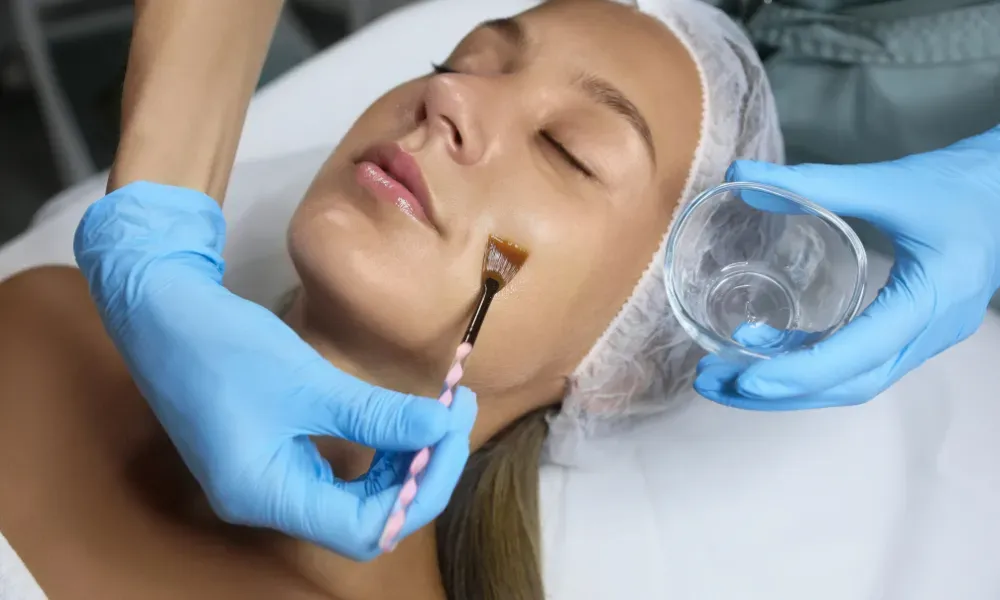
During the procedure, the professional applies the selected peel solution to the skin for a controlled amount of time.
You may experience:
-
Mild tingling
-
Warmth
-
Temporary stinging
-
Tightness
The intensity varies depending on the formulation and your individual sensitivity.
After the appropriate amount of time, the treatment is neutralized or removed according to the specific peel protocol.
What Happens After a Chemical Peel?
Your skin may appear slightly red or feel tight following treatment.
Depending on the peel, you may experience visible flaking or peeling over the following days.
Light peels may involve minimal downtime, while stronger peels can produce more noticeable peeling and require additional recovery.
MDCS Dermatology notes that downtime varies by peel type, with lighter treatments generally producing less peeling and deeper treatments requiring more recovery.
How Many Peels Will You Need?
One treatment may provide a visible improvement, but many patients benefit from a series of treatments.
MDCS Dermatology notes that a series of approximately three to six treatments, spaced several weeks apart, may be recommended depending on the patient's concerns and goals.
The ideal schedule depends on:
-
Skin type
-
Treatment strength
-
Pigmentation
-
Acne
-
Texture
-
Desired results
-
Previous treatments
-
Skin response
More treatments aren't necessarily better. Your skin needs adequate time to recover between procedures.
Professional Peels vs. At-Home Acids
There is an important difference between using an at-home exfoliating product and receiving a professional chemical peel.
At-home products are generally formulated for regular skincare use at lower concentrations.
Professional peels can use stronger formulations and require careful control of:
-
Concentration
-
Application
-
Contact time
-
Skin preparation
-
Treatment frequency
-
Aftercare
Higher-strength mandelic acid treatments should be performed by trained professionals rather than attempted at home. MDCS Dermatology emphasizes customized professional treatment and appropriate aftercare.
Why Skin Preparation Matters
Your results don't depend only on what happens during the appointment.
Preparing the skin appropriately can help minimize irritation and support recovery.
Depending on your treatment plan, you may be instructed to adjust certain active skincare products before your peel.
Be sure to tell your clinician about all products you're using, including:
-
Retinoids
-
Exfoliating acids
-
Acne medications
-
Prescription creams
-
Brightening products
-
Other recent cosmetic treatments
Don't Pick or Peel Your Skin
If your skin flakes following a chemical peel, resist the temptation to pull or scrub away the peeling skin.
Allow the skin to shed naturally.
Picking can increase irritation and potentially contribute to prolonged redness or pigmentation.
Follow your personalized post-treatment instructions carefully.
Sunscreen Is Essential
Chemical peels reveal newer skin at the surface, making sun protection especially important during the recovery period.
Use broad-spectrum sunscreen as directed and minimize unnecessary sun exposure.
Consistent sun protection also helps protect the improvements you achieve from future UV-related pigmentation and damage.
Who Should Avoid or Postpone a Chemical Peel?
Chemical peels aren't appropriate in every situation.
Treatment may need to be postponed or modified if you have:
-
An active skin infection
-
Significant irritation
-
A compromised skin barrier
-
Certain active inflammatory skin conditions
-
Recent excessive sun exposure
-
Recent aggressive cosmetic procedures
Your clinician will review your medical and skincare history to determine whether treatment is appropriate.
Meet Tamila Deveny, Aesthetician
Tamila Deveny, Aesthetician is the Head Clinical Aesthetician at MDCS Dermatology, with extensive experience in skin treatment and rejuvenation procedures.
She was nominated as "Best Medical Aesthetician" by SkinCeuticals in 2016 and previously worked with renowned dermatologists and venereologists in Europe. Her expertise includes chemical peels, microneedling, microdermabrasion, skin tightening, and acne treatment.
Tamila takes a personalized approach to skincare, considering each patient's skin type, concerns, and goals when developing a treatment plan.
Her work as part of the MDCS Dermatology team allows patients to benefit from an aesthetic approach that is integrated with comprehensive dermatologic care.
So, Which Chemical Peel Is Right for You?
There isn't a single peel that is best for everyone.
|
Skin Concern |
Peel That May Be Considered |
|
Sensitive skin |
Mandelic acid |
|
Acne and clogged pores |
Salicylic acid |
|
Dullness and texture |
Glycolic acid |
|
Acne + pigmentation |
Mandelic acid or Jessner's |
|
More significant pigmentation |
Glycolic, Jessner's, or TCA depending on the diagnosis |
|
Sun damage and texture |
TCA or other resurfacing options |
|
Fine lines and dullness |
Glycolic or retinol peel |
|
Overall radiance |
Mandelic, glycolic, or other customized peel |
This table is a general guide—not a substitute for an individualized evaluation.
The best treatment depends on the cause of the skin concern, not simply how strong the peel is.
The Bottom Line
Chemical peels can be an excellent way to refresh the skin, but choosing the right acid and treatment strength matters.
Mandelic acid is particularly appealing for patients who want effective exfoliation with a gentler approach, including many people with sensitive, acne-prone, or pigmentation-prone skin. Other options, including glycolic, salicylic, Jessner's, retinol, and TCA peels, may be better suited to different concerns.
At MDCS Dermatology, Tamila Deveny, Aesthetician can help evaluate your skin and determine which professional peel may best fit your goals. With multiple chemical peel options available across MDCS Dermatology locations, treatment can be tailored rather than approached as one-size-fits-all.
Ready to refresh your skin? Book Online to schedule your appointment.