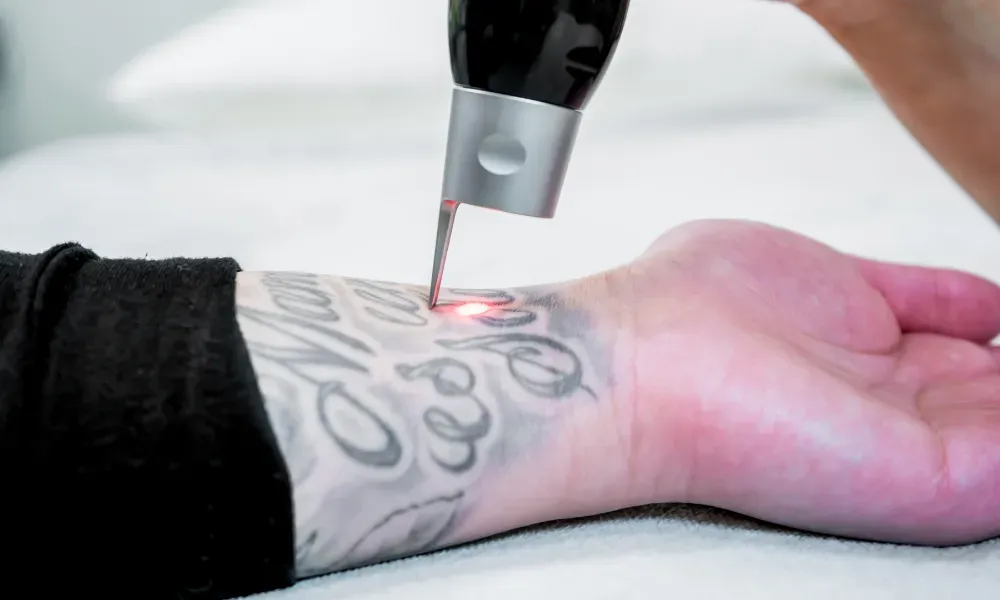
Laser tattoo removal uses concentrated light energy to break tattoo ink into smaller particles that the body gradually clears. Learn what affects treatment results, why multiple sessions are needed, and how personalized laser care can safely fade tattoos.
Tattoos are designed to be long-lasting, but personal preferences can change. Whether you want to completely remove a tattoo, fade it before a cover-up, or lighten an unwanted cosmetic tattoo, laser tattoo removal is one of the most established approaches for reducing tattoo pigment.
Modern laser technology works by delivering highly concentrated pulses of energy into the skin. Rather than simply “burning away” the tattoo, the laser targets tattoo pigment and breaks it into much smaller particles that the body can gradually clear.
At MDCS Dermatology, tattoo removal is approached with careful consideration of the tattoo’s color, depth, age, location, and the patient’s skin type. A personalized treatment plan can help balance effective ink clearance with skin safety.
How Does Laser Tattoo Removal Work?
Tattoo ink sits within the deeper layers of the skin. Because the pigment is too large for the body to efficiently remove on its own, tattoos can remain visible for many years.
Laser tattoo removal uses short pulses of concentrated light energy to target the ink particles.
The process generally works like this:
-
The laser targets the tattoo pigment.
-
Energy is absorbed by the ink.
-
The pigment particles are broken into smaller fragments.
-
The body gradually clears the fragmented pigment.
-
Additional treatments target remaining ink.
The laser is designed to preferentially target tattoo pigment while minimizing damage to the surrounding skin.
Why Does a Tattoo Fade After Treatment?
The laser treatment itself does not remove every ink particle immediately.
Instead, the energy breaks larger pigment particles into smaller fragments. The body's natural processes then gradually remove these particles.
This is one reason tattoo removal requires patience. The tattoo may continue to lighten between appointments even though no additional laser treatment is being performed.
Why Are Multiple Sessions Necessary?
One of the most common questions patients ask is, “Why can't the tattoo be removed in one treatment?”
There are several reasons.
Ink Is Deposited at Different Depths
Tattoo pigment may be distributed unevenly throughout the skin. Some particles are deeper than others and may require additional treatments.
Different Colors Respond Differently
Laser wavelengths interact differently with various ink colors. Black and dark pigments are often easier to target, while some lighter colors can be more challenging.
The Body Needs Time to Clear the Ink
After the laser breaks apart pigment, the body needs time to process and clear the smaller particles.
Skin Needs Time to Recover
Spacing treatments allows the treated area to heal and helps minimize the risk of irritation or pigmentary changes.
Which Tattoo Colors Are Easiest to Remove?
Tattoo removal depends heavily on the color and composition of the ink.
Black ink is often among the most responsive colors because it absorbs a broad range of laser energy.
Other colors, including certain shades of blue, green, red, yellow, and white, may require different approaches or may respond more slowly.
Some newer laser technologies can use multiple wavelengths to target different pigment colors.
What Determines How Easily a Tattoo Can Be Removed?
No two tattoos respond exactly the same way.
Several factors can influence treatment response, including:
-
Tattoo color
-
Ink density
-
Ink depth
-
Tattoo size
-
Location on the body
-
Age of the tattoo
-
Professional versus amateur tattoo
-
Type of pigment used
-
Patient's skin type
-
Individual healing and immune response
A consultation is important because these variables help determine the most appropriate treatment strategy.
Professional Tattoos vs. Amateur Tattoos
Professional tattoos often contain a greater concentration of pigment and may be placed more consistently at a specific depth.
Amateur tattoos may have less predictable pigment distribution.
This does not necessarily mean one type is always easier to remove. The specific tattoo characteristics matter more than whether it was professionally applied.
Does Tattoo Location Matter?
Yes. The location of a tattoo may affect how efficiently the body clears fragmented pigment.
Tattoos located closer to areas with good circulation may sometimes respond differently than tattoos located farther from the body's central circulation.
However, treatment response varies considerably between individuals.
What Does Laser Tattoo Removal Feel Like?
Patients commonly describe the sensation as a series of quick snaps or pulses against the skin.
Depending on the tattoo and treatment area, discomfort may vary.
A cooling method may be used to improve comfort during treatment and help protect the surrounding skin.
What Happens Immediately After Treatment?
Temporary skin changes are common after laser tattoo removal.
Patients may experience:
-
Redness
-
Swelling
-
Tenderness
-
Temporary whitening or frosting of the tattoo
-
Mild blistering in some cases
-
Crusting during healing
These effects are part of the skin's response to treatment and should be managed according to the specific aftercare instructions provided by the treatment team.
Why Is Aftercare Important?
Proper aftercare helps support healing and reduces the risk of complications.
Patients may be advised to:
-
Keep the area clean
-
Avoid picking or scratching the treated skin
-
Protect the area from sun exposure
-
Follow wound-care instructions
-
Avoid unnecessary irritation
-
Allow the skin to heal before resuming certain activities
Sun protection is particularly important because treated skin can be more vulnerable to pigmentation changes.
Can Tattoo Removal Cause Scarring?
Modern laser tattoo removal is designed to target pigment while minimizing injury to surrounding tissue. However, every procedure carries potential risks.
Possible complications can include:
-
Temporary or persistent changes in skin pigmentation
-
Blistering
-
Changes in skin texture
-
Scarring, although uncommon
-
Incomplete tattoo clearance
A careful evaluation and individualized treatment plan can help reduce these risks.
Tattoo Removal and Different Skin Types
Patients with darker skin tones can often undergo laser tattoo removal, but treatment parameters must be carefully selected.
The laser must distinguish between tattoo pigment and the natural melanin in the skin. Appropriate technology, settings, and treatment intervals can help minimize the risk of unwanted pigmentation changes.
This is one reason choosing an experienced dermatologic practice is important.
According to Snehal Amin, MD, FAAD
Snehal Amin, MD, FAAD brings extensive dermatologic and surgical expertise to the evaluation and treatment of skin concerns. At MDCS Dermatology, tattoo removal treatment is individualized based on the tattoo's characteristics, the patient's skin type, and the desired outcome.
A personalized approach is particularly important because tattoo removal is not a one-size-fits-all procedure.
How Long Does Tattoo Removal Take?
Tattoo removal is a gradual process.
Patients generally need multiple sessions, with adequate time between treatments for the skin to heal and the body to clear fragmented pigment.
The overall treatment timeline can vary considerably depending on:
-
Tattoo size
-
Ink color
-
Ink density
-
Tattoo location
-
Skin type
-
Response to previous treatments
Some tattoos fade substantially over a series of treatments, while others may require a longer treatment course.
Can a Tattoo Be Completely Removed?
Complete removal is possible in some cases, but it cannot be guaranteed.
Some pigments respond extremely well to laser treatment, while others may leave behind a faint residual shadow.
The goal may also be partial fading rather than complete removal, particularly when a patient wants to replace an existing tattoo with a new design.
Laser Tattoo Removal for Cover-Ups
Not everyone wants a tattoo completely removed.
Sometimes, the goal is to lighten an existing tattoo enough for a new tattoo to be placed over it.
In these situations, fewer treatment sessions may be needed than would be required for complete removal. The desired endpoint should be discussed during the initial consultation.
Why You Should Avoid DIY Tattoo Removal
Home tattoo-removal creams, abrasive techniques, and other do-it-yourself methods can cause significant skin injury without effectively removing deeper tattoo pigment.
Attempting to physically damage the skin may increase the risk of:
-
Scarring
-
Infection
-
Permanent pigmentation changes
-
Uneven skin texture
Professional laser treatment allows pigment to be specifically targeted while the surrounding skin is carefully considered.
When Should You Start Tattoo Removal?
Because tattoo removal requires multiple sessions, starting earlier gives the skin more time to progress through the treatment process.
If you are considering removal before a special event, cover-up, or change in personal preference, it is helpful to begin planning well in advance.
A consultation can provide a more realistic estimate of the number of treatments and timeline based on your specific tattoo.
What Should You Expect at Your Consultation?
During an evaluation, your dermatology team may assess:
-
Tattoo size
-
Ink colors
-
Skin type
-
Tattoo location
-
Ink density
-
Previous tattoo removal attempts
-
Desired degree of fading
This information helps determine whether laser tattoo removal is appropriate and what type of treatment plan may be recommended.
Frequently Asked Questions
Does laser tattoo removal work on all colors?
Different colors respond differently to laser energy. Dark pigments are often more responsive, while certain lighter colors can be more difficult to treat.
Can I remove only part of a tattoo?
Yes. Treatment can be targeted to specific areas when partial removal or fading is desired.
Can an old tattoo still be removed?
Yes. Tattoo age does not necessarily prevent treatment. In some cases, older tattoos may already have experienced some natural fading.
How far apart are treatments?
Treatment intervals vary, but sufficient time is generally allowed between sessions for the skin to heal and the body to clear fragmented pigment.
Will my tattoo disappear immediately?
No. The tattoo gradually fades as the body clears the pigment fragments after treatment.
Take the Next Step
Tattoo removal is a process rather than a single procedure. Understanding how laser energy interacts with tattoo pigment—and why multiple sessions are necessary—can help patients approach treatment with realistic expectations.
At MDCS Dermatology, treatment plans are customized according to the tattoo and the individual patient's skin characteristics, with an emphasis on safe treatment and gradual pigment reduction.
To schedule a consultation, Book Online.